Map the weld
01

Services
Repeatableweld paths
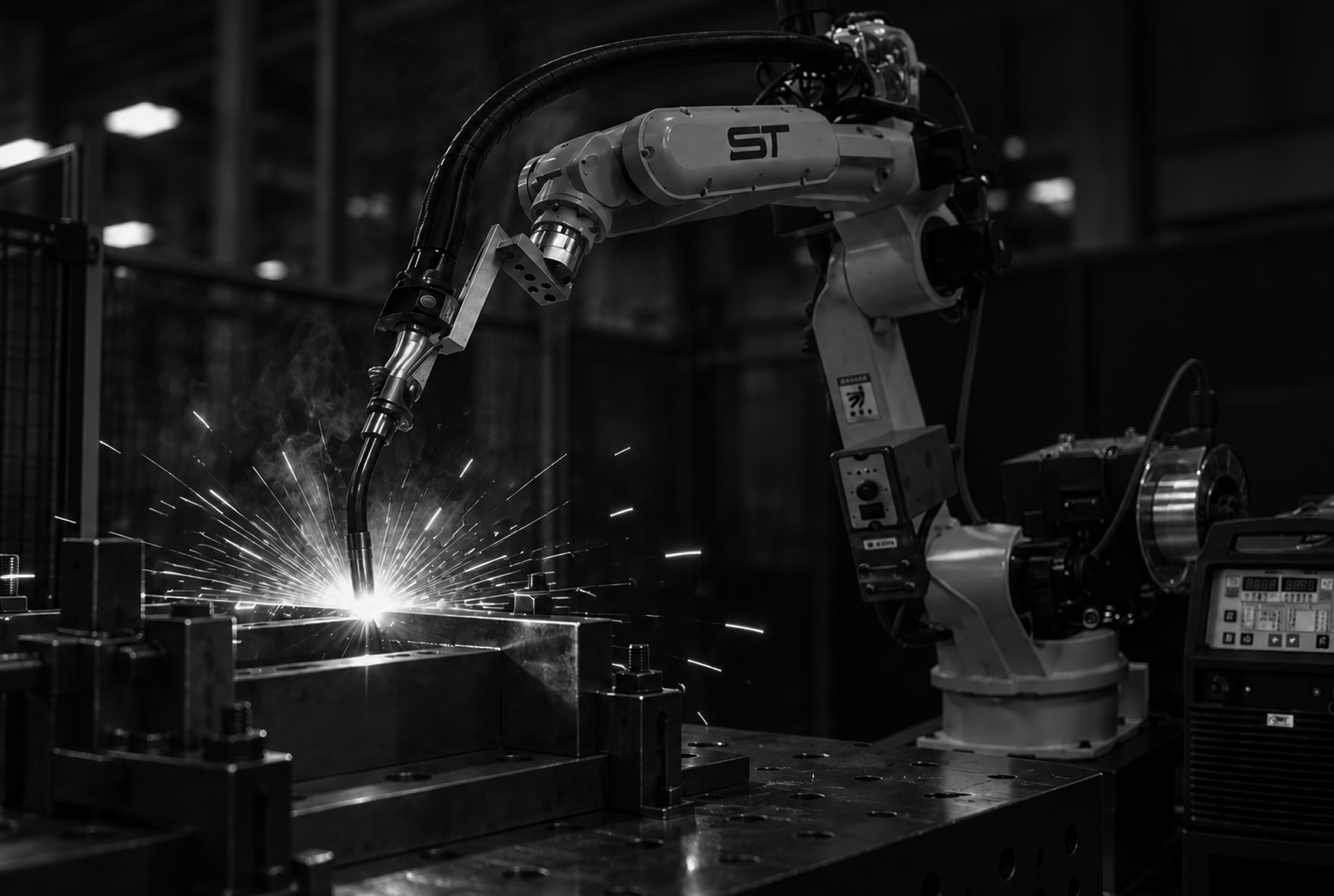
Repeat weld paths for frames and assemblies, programmed in North Jakarta. The same heat, speed, and bead on every cycle.
Capabilities
Terra Presisi Metalworks operates robotic welding cells in North Jakarta, providing automated MIG welding for high-volume production, repeat assemblies, and structural fabrication requiring consistent weld quality. Robotic welding reduces cycle time, minimizes spatter, and ensures repeatable penetration for applications where manual welding variability is not acceptable.
From drawing to handover
01
02
03
04
05
06
Applications
Typical work for robotic welding, fabricated in North Jakarta and shipped to site.
Questions
Robotic welding is ideal for production runs of 50+ units where weld consistency, cycle time, and repeatability are critical. Manual welding is more flexible for one-off custom work or assemblies with difficult access. We can advise which method suits your project during quoting.
Our robotic welding cells are set up for carbon steel (mild steel), stainless steel (304, 316), and duplex steel using MIG (GMAW) process. Aluminum and exotic alloys may require manual TIG welding due to process sensitivity.
Yes. For projects requiring weld traceability, we provide weld maps, welder qualification records, and process parameter logs. NDT (dye penetrant, ultrasonic, or radiographic testing) can be arranged through our accredited third-party inspection partners.
Fixture setup and programming investment makes robotic welding economical starting around 50–100 units, though this depends on part complexity. For smaller quantities or prototypes, manual welding is usually more cost-effective.
Yes, if the weld joints are accessible to the robotic torch and can be fixtured for consistent positioning. Complex geometries may require multi-axis positioners or indexing tables, which we can integrate into the cell setup.
First article setup including fixture fabrication and program validation takes 2–3 weeks. Once approved, production welding for batches of 100–500 units typically runs 1–2 weeks, depending on cycle time and finishing requirements.
